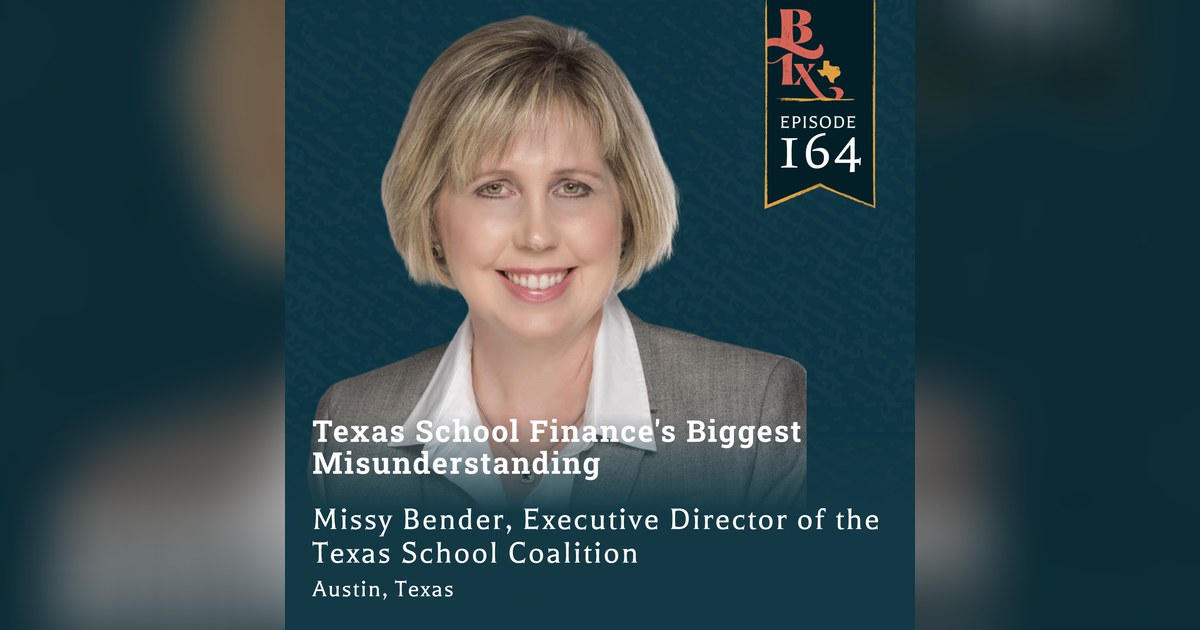
In the latest episode of The Building Texas Show, titled "Texas School Finance's Biggest Misunderstanding: Recapture Isn't Robin Hood," host Justin McKenzie and Missy Bender, Executive Director of the Texas School Coalition, dismantle a persistent policy myth surrounding the state's school finance system. Published July 13, 2026, the episode focuses on where the nearly $3 billion that Texas schools sent back to the state in 2025 through recapture actually ends up. With about 20% of all Texas districts now paying recapture, and a growing list of urban and rural payers, the conversation arrives as legislators head into election season.
Bender, a former Plano school board member turned statewide advocate, is blunt about the misconception baked into the program's nickname. "So what does recapture do? It generates state savings," she tells McKenzie. "That's why I don't call it Robin Hood anymore. It's not the property wealthy helping the property poor, like many think, but it's only helping the state." She adds that some boards have considered withholding payment as a form of protest, but warns, "you can actually go to jail for doing that." The exchange reframes a debate most Texans have only encountered as a tax-bill line item.
The episode breaks down the mechanics and consequences of the post-House Bill 3 formula in plain language. Listeners learn how property valuation divided by average daily attendance triggers the recapture threshold, and why declining enrollment plus rising valuations create a "double whammy" for districts like Plano ISD. The 2025 top payers are highlighted, including Austin ISD at $770 million and West Texas oil district Pecos-Barstow-Toyah at $198 million. Bender also explains why a student leaving for a doctor's appointment can cost a district a full day of state funding, even when the absence is excused.
The deeper policy conversation traces the money's path into the Foundation School Program (FSP) and out again as reduced state contributions, funds Bender says can then be redirected to "water, transportation, it could be vouchers, it could be anything." She cites the funding adequacy study led by Dr. Lori Taylor at Texas A&M, notes that the Legislature went six years without increasing the basic allotment despite inflation, and argues that 96% attendance, once religious and medical absences are counted, should be treated as the practical ceiling. She also flags legislation she is working on to stop penalizing districts for excused partial-day absences.
For more insights, listeners can access the full episode on YouTube or other podcast platforms. The Building Texas Show, hosted by Justin McKenzie, spotlights the operators, advocates, and civic leaders shaping the state's future through candid, long-form conversation. New episodes release every week across YouTube, Facebook, Instagram, and LinkedIn.