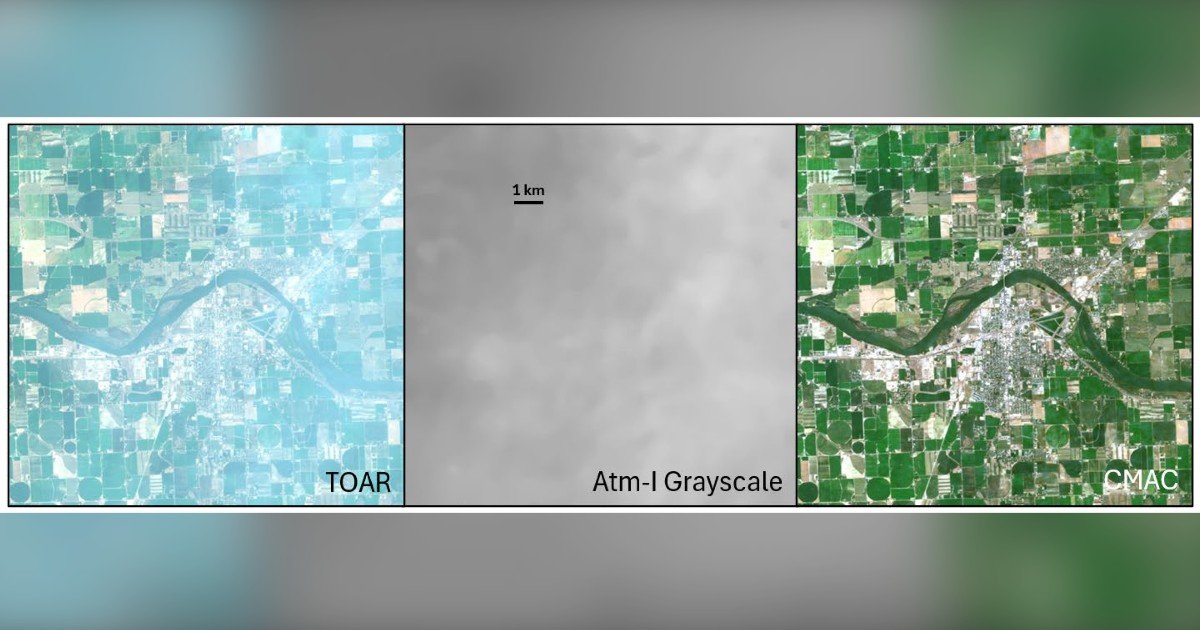
A new open-access paper from Resolv, Inc. argues that persistent problems with satellite imagery reliability and high costs in precision agriculture can be addressed by making accurate surface reflectance the standard output. The paper, “Surface Reflectance: An Image Standard to Upgrade Precision Agriculture,” was published March 30 in Remote Sensing by Dr. David Groeneveld and Tim Ruggles. It benchmarks three atmospheric correction methods on Sentinel-2 imagery and outlines how a reliable correction standard could enable low-cost, fully automated crop intelligence.
Atmospheric correction is critical because light traveling through the atmosphere distorts the signal before it reaches a satellite sensor. Correction reverses this distortion to return surface reflectance data needed for accurate crop analytics. When correction is inaccurate, small clouds and shadows can be mistaken for crop problems, triggering false alarms that cost time and money. Automated analysis has struggled to differentiate bad data from genuine issues, stalling progress in precision agriculture.
The Resolv team compared mainstream tools Sen2Cor and FORCE against CMAC, a closed-form atmospheric correction method developed by Resolv. Across various atmospheric conditions, CMAC produced precise and accurate surface reflectance estimates, while the two mainstream methods showed systematic errors—over-correcting clear images and under-correcting hazy ones. This bias had gone undetected until the paper surfaced it.
Reliable surface reflectance unlocks several applications: automated removal of clouds and shadows to reduce false alarms, an automated crop start-date index that could replace growing-degree-day scheduling, stable NDVI readings despite atmospheric water vapor variation, soil capability classification directly from imagery for variable-rate seed and fertilizer application, and accurate remote crop irrigation based on greenness and reference evapotranspiration to boost yield and save water. Together, these applications offer a path for precision agriculture to pay for itself.
To address high image costs, the paper proposes a tiered model: Tier 1 uses free Sentinel-2 imagery corrected to surface reflectance, and Tier 2 fills gaps with commercial smallsat data when clouds block Sentinel-2. The smallsat data can be resampled, verified, and billed automatically with no human intervention. This could create a turnkey pipeline for ordering, correcting, analyzing, and billing imagery across vast regions, lowering service costs and increasing image sales volume. Crop insurance could serve as a natural channel for streamlining loss adjustment while protecting grower privacy.
“Remote sensing has spent years over-promising and under-delivering for agriculture,” the authors state. Reliable surface reflectance, they argue, can finally close the gap. The paper is available as an open-access resource. Resolv’s CMAC technology, developed with National Science Foundation SBIR funding, is now being readied for commercial rollout. More details can be found on their website.