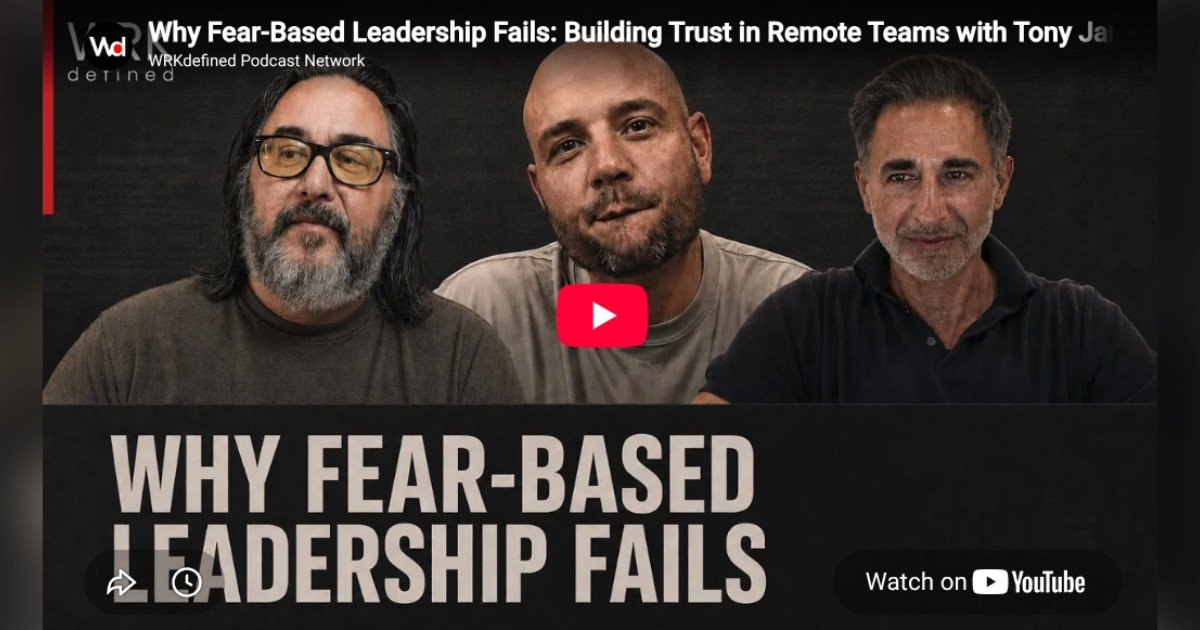
In a recent episode of the podcast You Should Know, Oyster founder and Executive Chairman Tony Jamous delivered a stark warning to executives: leadership rooted in fear is quietly undermining their organizations. The episode, titled "Why Fear-Based Leadership Fails: Building Trust in Remote Teams with Tony Jamous," was hosted by William Tincup and Ryan Leary and recorded with Jamous from Cyprus. Jamous argued that surveillance, reactivity, and command-and-control instincts are not strategic approaches; they are manifestations of fear, and they are increasingly incompatible with a distributed, global workforce.
The conversation delved into why the pendulum between progressive and traditional leadership has swung back toward control as economic pressures mounted. Jamous pointed to rising interest rates and slowing demand as triggers that have made executives more anxious and more prone to revert to old habits. However, he contends that this reaction is counterproductive. "One of the most damaging stories leaders tell themselves is that if they missed the quarter or the year, they're going to die," he said, framing Wall Street pressure as a wiring problem rather than a business reality.
Jamous, who previously took an API software company public before it was acquired, described a personal evolution between his first and second unicorn as "ego reduction." He credited a pivotal observation from his leadership coach, Pascal, after his first exit: that the same outcome could have been achieved by taxing himself and those around him less. This insight led him to develop a three-part method for shifting from control to trust: defaulting to best intent, practicing non-reactivity, and releasing the illusion of control.
As the leader of Oyster, a benefit corporation operating across more than 80 countries, Jamous uses remote work as a forcing function for trust. He stressed that "you have 100% control by controlling your behavior at the top as a leader of the organization," and that leaders must "default to assuming best intent." The episode also touched on the launch of Oyster's Global Payroll product and the company's Silver Lake-led funding round closed in Q3 of the prior year.
The discussion extended to hiring for ethics, with Jamous arguing that ethical environments are built, not screened for. He shared an emotional story of an Oyster teammate in the Philippines who broke down when she realized she was trusted, illustrating the profound impact of a high-trust culture. The concept of a "clean company" vibrating at high trust was also explored, as was Oyster's mission to reverse brain drain and reduce wealth inequality by democratizing access to global job opportunities.
Jamous was direct about the psychology driving executives into old habits. "One of the most damaging stories leaders tell themselves is that if they missed the quarter or the year, they're going to die," he reiterated, emphasizing that this mindset leads to micromanagement and a toxic work environment. Instead, he advocates for a leadership style that prioritizes trust, transparency, and empowerment.
The episode, available now on the WRKdefined Podcast Network, reaches more than 3.9 million verified listeners each month. Co-hosted by Ryan Leary and William Tincup, the show tackles pivotal leadership challenges, workforce dynamics, and the impact of technology on hiring. For more insights from Jamous and the hosts, listeners can visit wrkdefined.com.